
The Puddle That Won’t Go Away
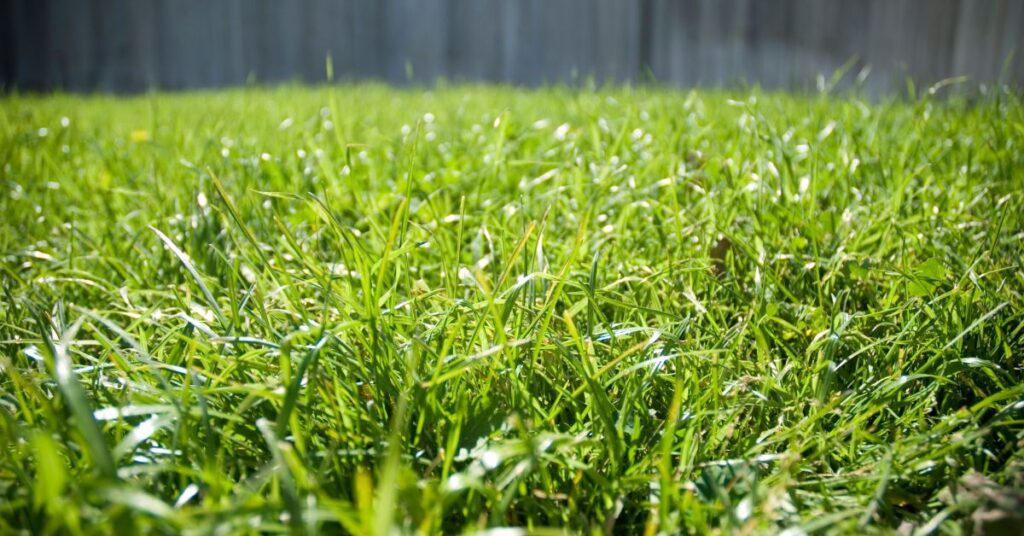
It’s been three days since the last rain. Your neighbor’s yard is dry. The yard across the street looks fine. But there’s your backyard in Grand Ledge, still holding a puddle the size of a kiddie pool in the same spot it’s been for the past five years.
Every spring, same story. Every heavy rain, same puddle. The clay soil common throughout Michigan makes it worse. Water doesn’t absorb like it should. You’ve tried grading it yourself with a rake. You’ve added topsoil. You’ve even stopped watering that section, hoping it would dry out faster. Nothing works. The water just sits there, killing your grass, attracting mosquitoes, and making that whole corner of your yard unusable for a week after every storm.
Here’s what’s actually bothering you. It’s not just the puddle. It’s the nagging feeling that something’s wrong underneath your property that you can’t see. It’s wondering if that water is slowly damaging your foundation. It’s the embarrassment when friends come over for a backyard barbecue and you have to explain why part of your outdoor living space looks like a swamp. It’s knowing you’re losing usable outdoor space that you paid good money for.
And here’s what most homeowners in Portland, Eagle, and Grand Ledge don’t realize until it’s too late. That standing water isn’t your real problem. It’s a symptom. The real issue is where that water’s trying to go and what’s stopping it from getting there. Sometimes a French drain fixes it. Sometimes it makes things worse. Sometimes you don’t need a French drain at all. Knowing the difference saves you thousands of dollars and a torn-up yard.
What to Watch For During February’s Thaw: This week, as temperatures rise above freezing, watch what happens when snowbanks melt against your foundation. Does the water create a “moat” around your house? Do you see ice lenses forming in your soil where water freezes and thaws repeatedly? These aren’t just winter problems. They’re showing you exactly where your drainage fails when spring rains come. Pay attention now, and you’ll know what needs fixing before April’s heavy storms hit.
The Drainage System Your Yard Is Begging For
We’re Kanazeh Lawn Service, and we’ve installed drainage systems across the greater Lansing area for over 35 years. We’re Unilock Authorized Contractors, which means we’ve passed rigorous inspections on drainage installation, retaining wall construction, and hardscaping work that meet Unilock’s strict standards. We don’t just dig trenches and hope for the best.
Serving Grand Ledge, Portland, Eagle, Wacousta, Delta Township, and the West Lansing area means we understand your soil. We know about the heavy clay that doesn’t drain. We know about the shale deposits in Grand Ledge, especially near Fitzgerald Park, that make digging harder. We know about Michigan’s 42-inch frost line and what happens when drainage systems are installed too shallow. Whether you’re in a newer development in Eagle with disturbed topsoil, an established property in Shadow Ridge dealing with persistent wet spots, a Delta Township home built on former farmland with poor drainage, or near the Looking Glass River where the water table sits high, we’ve seen your exact situation before.
We’re not coming from East Lansing with generic solutions and travel fees. We’re your neighbors. We’ve been fixing drainage problems in your backyard for three decades.
Here’s the pattern we see constantly. A homeowner calls us about standing water. They’ve already decided they need a French drain because that’s what Google told them. Half the time, they’re right. The other half, a French drain would be a waste of money because the real problem is somewhere else entirely. Maybe their yard slopes toward the house instead of away from it. Maybe they need a retaining wall to manage a hillside common in this area. Maybe their downspouts are dumping thousands of gallons right where they don’t want water. Maybe they just need better grading.
We use what we call the “Water Wants to Go Somewhere” assessment. Water always flows downhill and always takes the path of least resistance. When water’s pooling in your yard, it means one of three things. Either it can’t flow away because there’s nowhere for it to go, it’s being blocked by something (like our heavy clay soil or a poorly graded section), or you’re sending it there on purpose without realizing it (gutters, slopes, neighbor’s runoff flowing onto your property).
We’ve seen properties where simple yard regrading solved a five-year drainage problem in an afternoon. We’ve also seen properties in Eagle and Portland where the homeowner needed a French drain, a retaining wall, AND new grading because they had legitimate hillside erosion. The difference isn’t obvious until someone who knows West Lansing drainage actually looks at the whole picture.
Our Low-Impact Promise: We know you’re worried about what installing a French drain will do to your lawn, especially if you’re in Wacousta or rural Eagle where protecting your property matters. That’s why we use mini-excavators with rubber tracks, not massive machines that tear up everything in sight. We lay down plywood mats to protect your grass in high-traffic areas. We’re not the “big yellow machine” contractors. We’re the ones who treat your property like it’s our own and leave your yard looking as good as possible while fixing what’s broken underneath.
Image Caption: We use low-impact equipment like this mini-excavator with rubber tracks to ensure your Grand Ledge lawn stays as protected as possible during the dig.
5 Signs You Actually Need a French Drain
Why Does Water Pool in the Same Spot in My Grand Ledge Yard?
This is the most obvious sign, but here’s what matters. The water needs to pool in the same location consistently, not randomly around your yard. If your standing water moves around depending on which direction the rain comes from, that’s not a French drain problem. That’s a grading problem.
Real French drain candidates have water that collects in one specific low spot every time it rains. The water sits there for days, sometimes a week or more, even after everything else has dried out. You can see the grass dying in that exact spot season after season. That’s your yard telling you there’s nowhere for water to go from that location.
Here’s the test. Next time it rains, watch where the water goes. If it all flows to one spot and then just sits there with nowhere to drain, you probably need a French drain. If it’s spreading out randomly or pooling in different places, you need professional grading work first.
In the West Lansing area, especially in Grand Ledge, Okemos, Wacousta, and Portland, our clay soil makes this worse. Clay doesn’t absorb water fast like sandy soil does. Once water collects in a low spot, it’s stuck there until it evaporates. A French drain gives it somewhere to go instead. The drain creates an underground path where water can flow away from problem areas, protecting your foundation and giving you dry, usable yard space.
When Hillside Erosion Means You Need More Than Just a French Drain
If your property has any kind of hill or slope (common throughout Grand Ledge and the surrounding areas), you’re dealing with a completely different drainage situation. Water running down a slope picks up speed and volume. By the time it reaches the bottom, it’s carrying soil, mulch, and whatever else is in its path. This is where French drains pair with retaining walls to create a complete solution.
Here’s what we see constantly in West Lansing properties, especially in areas like Tallgate, Delta Township near the mall developments, or the hillier sections near Fitzgerald Park. A home has a sloped backyard. Every heavy rain, water rushes down the hill, carves channels through the grass, washes away landscaping, and dumps everything at the bottom near the house foundation or patio. The homeowner thinks they just need better grass or more mulch. What they actually need is a way to intercept that water halfway down the hill before it becomes a problem.
A French drain installed behind a retaining wall catches water as it moves downhill and redirects it to a safe discharge point away from problem areas. The retaining wall manages the soil and creates terraced levels. The French drain manages the water behind the wall. They work together as a system. According to drainage engineering principles, proper integration of walls and drainage prevents the hydrostatic pressure that causes wall failure.
This is why we’re Unilock Authorized Contractors. Proper retaining wall installation requires understanding drainage, soil pressure, and how water moves through different materials. We don’t just build walls that look good. We build walls with proper drainage behind them so they’re still standing strong twenty years later when winter freeze-thaw cycles have destroyed improperly installed walls. Unilock backs our work with a two-year workmanship guarantee because they know we install drainage systems correctly the first time.
Can a French Drain Stop Basement Water Problems?
If your basement gets damp or shows water stains after heavy rain, that’s water finding a way to your foundation. This is the scenario where a French drain isn’t optional, it’s necessary for protecting your home’s structure.
Foundation drainage is serious business. Water sitting against your foundation creates pressure. Over time, that pressure finds cracks, causes settling, and leads to expensive foundation repairs that can cost tens of thousands of dollars. A properly installed foundation drainage system around your foundation intercepts water before it reaches the basement walls and redirects it to a safe drainage point away from the house.
Here’s what makes this tricky. Sometimes the water causing basement dampness isn’t coming from your property at all. It might be your neighbor’s runoff. It might be poor grading that slopes toward your house instead of away from it. It might be downspouts dumping water right next to your foundation.
Before installing a foundation French drain, we assess where the water’s actually coming from. Sometimes fixing downspout extensions and regrading solves the problem for a fraction of the cost. Other times, you need the full perimeter French drain system. The key is diagnosing correctly before anyone starts digging up your yard. Contact us for a free assessment if you’re experiencing basement moisture issues.
When Retaining Walls Require Drainage (You Don’t Have a Choice)
If you’re planning any retaining wall installation, you need drainage behind it. Period. This isn’t optional. Retaining walls without proper drainage fail. They bow, crack, and eventually collapse because water pressure builds up behind them with nowhere to go. We’ve seen it happen to beautiful walls that cost homeowners thousands of dollars.
Every retaining wall we install as Unilock Authorized Contractors includes proper drainage as part of the system. That means gravel backfill, heavy-duty drainage pipe along the base, and drainage outlets that direct water away from the wall structure. This is part of Unilock’s installation standards and exactly why they back our work with their guarantee.
We’ve repaired too many failing retaining walls across the Lansing area that were installed by other contractors without drainage. The wall materials were fine. The installation was terrible. Water destroyed the wall from behind within a few years. Don’t let that happen to your property. Ask any contractor about their drainage plan before they touch your retaining wall project.
When You DON’T Need a French Drain
Here’s when French drains won’t help. If your whole yard is soggy (not just one spot), you have a grading problem or your property sits in a naturally wet area. If water pools in different spots depending on the rain, you need better overall grading. If you have downspouts dumping thousands of gallons right where you don’t want water, fix the downspouts first before spending money on underground drainage.
Sometimes the solution is simpler and cheaper than a French drain. Better landscape grading costs less. Extending downspouts costs almost nothing. Adding soil to low spots and creating proper slopes often solves the problem without any drainage pipes at all. We’ll tell you honestly which solution your property actually needs.
French Drain vs. Other Drainage Solutions
Understanding the difference between drainage solutions helps you make a smart decision about what your property actually needs.
A French Drain works for groundwater problems. It’s an underground system that pulls water out of saturated soil and moves it away from your property. Water seeps into a perforated pipe buried in gravel, then flows through that pipe to a discharge point. Best for persistent wet spots in the same location, hillside water interception, foundation protection, and retaining wall drainage.
A Catch Basin with Trench Drain works for surface water that collects in one spot quickly. It’s designed to capture water fast from driveways, patios, or low areas and move it through pipes to a discharge point. You’ll see the grate on top where water enters. Best for driveway drainage, patio runoff, or collecting water from specific problem spots where surface water needs quick removal.
Simple Yard Grading works when water flows the wrong direction. If your yard slopes toward your house instead of away from it, no amount of drainage pipes will fix the fundamental problem. The water needs to flow differently across the surface before you even think about underground systems. Best for properties where the overall slope creates the drainage issue.
The right solution depends on your specific situation. Surface water problems often need surface solutions. Underground water problems need underground solutions. Sometimes you need both. That’s why honest assessment matters more than selling you the most expensive option.
How Long Does a French Drain Last in Michigan Weather?
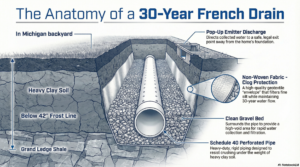
A professionally installed French drain in Mid-Michigan typically lasts 20 to 30 years, provided it uses non-woven geotextile fabric and is buried below the 42-inch frost line.
Here’s what makes the difference. Cheap installations use thin corrugated pipe wrapped in a sock. That pipe crushes under soil weight. The sock clogs with dirt within 5 years. Michigan’s freeze-thaw cycles destroy shallow installations. We’ve seen homeowners spend money on French drains that failed in less than a decade because the contractor cut corners.
Quality installations use heavy-duty perforated pipe (the kind that won’t collapse under Michigan soil), proper filter fabric (the kind that keeps dirt out without clogging), and clean gravel (not just whatever’s cheapest). The system gets installed below Michigan’s 42-inch frost line so winter doesn’t damage it. That’s not negotiable in our climate. Go shallow, and February’s freeze-thaw cycles will destroy your investment.
We use materials that last because our reputation depends on it. When a homeowner in Shadow Ridge, Wacousta, or near the Looking Glass River calls us back 15 years later for a different landscaping project, we want their French drain still working perfectly.
Here’s the distinction that matters. The pipe itself might have a manufacturer’s warranty. But that’s not what protects you. What protects you is Kanazeh Lawn Service’s workmanship guarantee, backed by Unilock’s rigorous standards. When we say it’s installed correctly, Unilock has inspected our work and verified it meets their requirements. That separates us from contractors who disappear after the first rainstorm when their cheap installation fails.
The materials cost more up front. But you’re not paying someone to dig up your yard again in 8 years when thin pipe collapses and sock fabric clogs.
Simple Maintenance for a 30-Year Drain
Even the best-installed French drain needs minimal maintenance to last its full lifespan. Here’s what we recommend for homeowners in Grand Ledge, Portland, and throughout West Lansing.
Check your pop-up emitter twice a year. That’s the point where water exits the system, usually a small grate in your yard or near the street. In spring and fall, make sure it’s not covered by leaves, mulch, or debris. Takes two minutes. Prevents clogs that can back up your entire system.
Keep mulch away from discharge points. When you’re landscaping or refreshing mulch beds, don’t pile it over where your French drain exits. Water needs a clear path out. Covering the discharge point forces water to find another way out or back up into the system.
Watch for settling. Over years, soil can settle slightly above the drain line. If you notice a depression forming where the drain runs, add some topsoil and reseed. This prevents water from pooling on the surface right above your underground drainage.
That’s it. No complicated maintenance. No annual service calls. Just basic attention twice a year keeps a quality system running for three decades. If you need help or notice any issues with your existing French drain, contact our team for a quick inspection.
What Affects French Drain Installation Cost
French drain installation typically costs $20 to $50 per linear foot. That’s the industry range you’ll see across professional contractors. Where you fall in that range depends on several factors.
The soil type matters. Grand Ledge’s shale deposits, especially properties near Fitzgerald Park, require specialized equipment. Heavy clay common in Wacousta and Delta Township is harder to dig than sandy soil. Rocky terrain means more labor and tougher equipment.
The depth and length matter. A shallow 30-foot drain costs less than a deep 100-foot perimeter system around your foundation. Going below the 42-inch frost line (necessary in Michigan for systems that survive winter) means more digging, more time, and more expertise.
The discharge location matters. If we can drain water to a nearby area, that’s straightforward. If we need to run pipe 200 feet to reach a drainage ditch, storm sewer, or safe discharge point, that’s more material and more labor.
The equipment needed matters. Small yards in established neighborhoods need compact equipment. Large rural properties in Portland or Eagle need different machinery. Either way, we protect your lawn with the right tools for your specific property.
Here’s why cheaper isn’t always better. We’ve seen $10-per-foot French drain installations. They used thin pipe, no proper fabric, and installed everything too shallow. Three years later, the homeowner called someone else (often us) to fix the failed system. Now they’ve paid twice and still dealt with drainage problems for years in between.
Quality materials and proper installation cost more. But you’re getting a system that works for 25 years instead of failing in 5. That’s the difference between a permanent solution and an expensive temporary fix.
Where Does the Water Go? (The Neighbor Question)
This is the question that keeps rural and suburban homeowners up at night. If you install a French drain, where does all that water end up? Can you just pipe it onto your neighbor’s field? What if it causes problems downstream?
Here’s the truth. In Michigan, you cannot simply dump water onto your neighbor’s property. There are drainage laws, and more importantly, there’s basic respect for the people who live around you. Professional contractors understand this. Amateur contractors or DIY installations often don’t think about it until someone’s furious neighbor shows up asking why their yard just turned into a swamp.
We plan discharge points carefully. Water might drain to a storm sewer if one’s accessible and permitted. It might discharge into a drainage ditch or culvert designed to handle runoff. It might flow to a dry well on your own property that absorbs water slowly. It might exit through a pop-up emitter that spreads water across a safe area where it won’t cause erosion or neighbor disputes.
What matters is this. When we design your French drain system, we’re not just thinking about where water comes from. We’re thinking about where it goes, what that does to surrounding properties, and whether the discharge plan is legal, respectful, and sustainable. That’s what 35 years of experience and a reputation in Grand Ledge, Portland, Wacousta, and Eagle gets you. We’re not leaving town after the job. We live here. We see you at the hardware store. Your neighbors might be our next customers.
Any contractor who doesn’t discuss the discharge point with you doesn’t understand drainage. Water has to go somewhere. Make sure that somewhere is legal, ethical, and won’t create new problems downstream.
3 Red Flags of Bad Drainage Contractors
After 35 years installing drainage systems across West Lansing, we’ve seen what bad contractors do. Here’s what to watch out for when someone gives you a quote.
Red Flag 1: They Don’t Ask Where the Water Goes
Any contractor who doesn’t discuss the discharge point doesn’t understand drainage. Water has to go somewhere. Dumping it on your neighbor’s property creates legal problems and angry neighbors. Discharging into the wrong area can cause new erosion or violate local codes. If a contractor shows up, looks at your wet spot, and says “We’ll dig a trench and bury pipe” without ever asking where that pipe drains to, show them the driveway.
Good contractors plan the entire water path from collection to discharge. We talk about your property’s slope, where storm sewers are located, what your neighbors’ drainage looks like, and what discharge options make sense. That’s not extra service. That’s basic professional competence.
Red Flag 2: They Use Cheap Materials (Or Won’t Explain Their Materials)
Thin corrugated pipe costs less and fails fast. No filter fabric or the wrong kind means clogs within years. If a contractor won’t explain what specific materials they’re using, that’s a warning sign. If they say “all pipe is the same” or “don’t worry about the details,” they’re either ignorant or dishonest.
Ask about pipe type. Ask about fabric. Ask about gravel. Ask about depth below the frost line. Professional contractors answer these questions clearly because they know their work depends on quality materials. If a contractor gets defensive or vague when you ask about materials, that tells you everything you need to know. If they show up without a laser level to ensure proper slope, that’s another red flag that they’re guessing instead of engineering.
Red Flag 3: They Won’t Pull Permits When Needed
Permit requirements vary by township in the Lansing area. Some projects need permits, especially when connecting to storm sewers or affecting drainage between properties. Professional contractors know the rules in Grand Ledge, Eagle, Portland, Delta Township, and surrounding townships. They handle permits as part of the job.
Contractors who skip permits either don’t know the rules or don’t care. Either way, you’re the one who’s liable if something goes wrong. If your township requires a permit and you didn’t get one, that’s your problem when code enforcement shows up, not the contractor who’s already cashed your check and moved on to the next job.
We handle permits when needed, use quality materials every time, and plan complete drainage solutions from start to finish. That’s what keeps us in business for 35 years while fly-by-night contractors come and go.
What Happens Next
Spring thaw is coming to West Lansing. That’s when Grand Ledge homeowners see exactly what winter did to their drainage. Freeze-thaw cycles crack poorly installed systems. Spring rains reveal grading problems that were hidden under snow. Water pooling on frozen ground in February tells you one thing. Water still pooling in March after the ground thaws tells you something different. Your yard is showing you what needs fixing. Are you paying attention?
The good news? Proper drainage installation done right, with quality materials and Michigan-specific expertise, lasts 25-30 years. This isn’t a temporary fix or a band-aid solution. It’s a permanent answer that protects your property and gives you peace of mind every time it rains.
If you’re dealing with standing water, basement dampness, hillside erosion, or any drainage issue across your Grand Ledge, Portland, Wacousta, Delta Township, or Eagle property, we’ll come assess the situation and give you honest recommendations. Sometimes that means a French drain. Sometimes it means regrading. Sometimes it means a retaining wall with proper drainage behind it. Sometimes it means fixing your downspouts and calling it a day. Whatever your West Lansing property actually needs, that’s what we’ll recommend. We’re not here to sell you the most expensive option. We’re here to solve your drainage problem.
As Unilock Authorized Contractors, we’ve passed rigorous inspections on our drainage work, hardscaping installation, and retaining wall construction. Unilock backs our work with a two-year workmanship guarantee because they’ve verified we install systems correctly. That kind of backing doesn’t come easy. It means we’ve proven ourselves through multiple completed projects, homeowner references, and quality inspections over years of work. It means when we say it’s done right, it’s actually done right.
We serve Grand Ledge, Portland, Eagle, Wacousta, Delta Township, and the greater Lansing area. We’ve been doing this for over 35 years. We know Michigan soil, Michigan weather, and Michigan drainage problems. We understand the Grand Ledge shale, the West Lansing clay, the hillside properties common in your area, the former farmland drainage issues in Delta Township. We’re not guessing based on something we read online. We’re applying three decades of local experience to your specific property.
Schedule a free drainage assessment. Call 517 719 8754 or visit lansinglawnandsnow.com/contact.
No pressure. No sales pitch. Just an honest assessment of what your property needs and what it’ll cost to fix it permanently. You deserve to know the truth before anyone starts digging up your yard. We’ll tell you that truth, even if it means less money for us, because we’d rather earn your trust than make a quick buck.
Your yard should work for you, not against you. Let’s fix what’s broken so you can actually enjoy your outdoor space instead of watching puddles sit there for a week after every rain..
About Kanazeh Lawn Service
Kanazeh Lawn Service has served the Grand Ledge, Portland, Eagle, Wacousta, Delta Township, and West Lansing areas for over 35 years. As Unilock Authorized Contractors, we specialize in drainage solutions, French drain installation, retaining walls, and hardscaping that lasts decades in Michigan weather. Our work is backed by Unilock’s two-year workmanship guarantee and 35 years of local reputation.
Contact Information:
Phone: 517.719.8754
Website: lansinglawnandsnow.com
Services: Landscaping | Hardscaping | Patios & Retaining Walls | Snow Removal